


Ⅰ. 서론
2016년 임상가를 위한 특집에서 투명교정 장치의 이해를 주제로 집필한 후 오랜 시간이 흘렀다. 투명교정장치 관련 신소재 개발로 물리적 특성이 개선되고 있어 장치의 임상 성능 향상을 기대하고 있다[1]. 투명교정장치는 원하는 치아 이동을 달성하기 위해서는 치아에 지속적이고 조절된 힘을 가해야 한다. 그러나 투명교정 소재는 교정용 초탄성 와이어와 달리 장치의 장착 후 단기적 또는 장기적 응력완화가 크게 발생되는 점이 특징적이다. 또한 투명교정 장치는 치아 모델을 제작하고 교정 장치를 다듬어야 하는 복잡한 제조 공정으로 열가소성 소재의 열성형 공정이나 직접 출력 중에 다양한 정도의 수축 및 팽창이 일어날 수 있다. 이러한 변화들은 치아 부위별 두께나 적합도에 영향을 미칠 수 있으며 투명장치의 임상적인 치료 목표 달성을 어렵게 만들 수 있다.
최근 투명교정 치료의 예측도를 높이기 위해 물리적인 특성을 향상시킨 다층 레이어의 투명교정 제품들이 소개되었으며 최근에는 직접 프린팅 재료까지 소개되면서 투명교정 장치의 혁신적인 제조 방법이 가능하게 되었다. 직접 프린팅 재료 중에 형상 기억 특성 등이 보고되어 관련 소재에 대한 관심이 높아지고 있다. 이번 호에서는 투명교정 관련 최신 재료에 대하여 소개하고 올바른 사용을 위해 임상가가 알고 있어야 하는 물리적, 생물학적 특성을 설명하고자 한다.
Ⅱ. 본론
■ 최신 투명교정 재료 분류
투명교정 재료는 일반적인 PVC, PET, PETG, PU, polycarbonate 재료가 사용되고 있으며 해당 재료의 특성은 2016년 임상가를 위한 특집을 참고하시기 바란다. 이러한 재료 등은 장기적인 구강내 환경에서 물리적인 한계가 있기 때문에 새로운 재료들이 지속적으로 개발되고 있다.
최신 열성변형 투명교정 재료는 단층과 다층구조로 분류될 수 있다. 단층의 경우 PET, PTU, Polycarbonate 재료 등으로 구성되며 대부분 10~15% 이상의 변형이 주어질 경우 항복강도를 초과하여 원상태로 돌아오기 어렵게 된다[2]. 각각의 제품에 따른 물리적 특성이 보고되었으나 서로 다른 투명교정 재료에 대한 임상적인 효과에 대한 연구는 여전히 부족하다.
반면 다층구조의 투명교정 재료는 단층구조와는 달리 지속적인 응력을 나타낼 수 있다. 다층 재료는 동일 재료나 이종 재료로 구성되어 있으며 절대적인 응력은 단일층에 비해 4배정도 낮다고 보고되고 있고. 다층 구조의 경우 SmartTrack(LD30, Align Technology, Inc., San Jose, CA, USA)은 polyurethane/co-polyester 재료로 다층구조로 구성되어 있으며 MagicFoil (Osstem, Seoul, Korea)의 경우 PU의 다층 구조로 구성되어 있다. 반면 CA pro(Scheu-Dental, Iserlohn, Germany) 제품의 경우 copolyester의 외곽층과 내부의 탄성 물질로 구성되어 있다(Table 1).
직접 프린팅 재료는 3D 프린팅을 이용하여 직접 출력할 수 있다는 점에서 높은 관심을 보이는 재료이다. 하지만 3D프린팅 출력 후 추가 공정을 통해 잔여 레진을 제거하고 2차 중합과정이 필요하게 된다. 잔여 레진 제거 시 알코올을 사용할 경우 투명도가 사라질 수 있어 원심분리방식이 사용되고 있다. 직접 프린팅 재료로는 PU 계열이나 acrylic ester 재료가 소개되고 있다(Table 1). 2차 광중합을 시행할 경우 물리적인 저항성은 75% 정도 향상되며 변형은 70% 정도로 감소되어 깨지기 쉬울 수 있으며 높은 강성을 보이게 된다. 직접 프린팅 재료는 적합성이 우수하다고 보고되고 있으나 열성변형보다는 낮은 적합도를 보인다는 연구도 있어 프린팅 방식과 사후 공정에 따른 다양한 연구가 필요하다. 최근에 직접 프린팅 재료에 형상기억 성능이 보고되어 이에 대한 관심이 더욱더 높아지고 있다.
■ 최신 투명교정재료의 물리적 특성
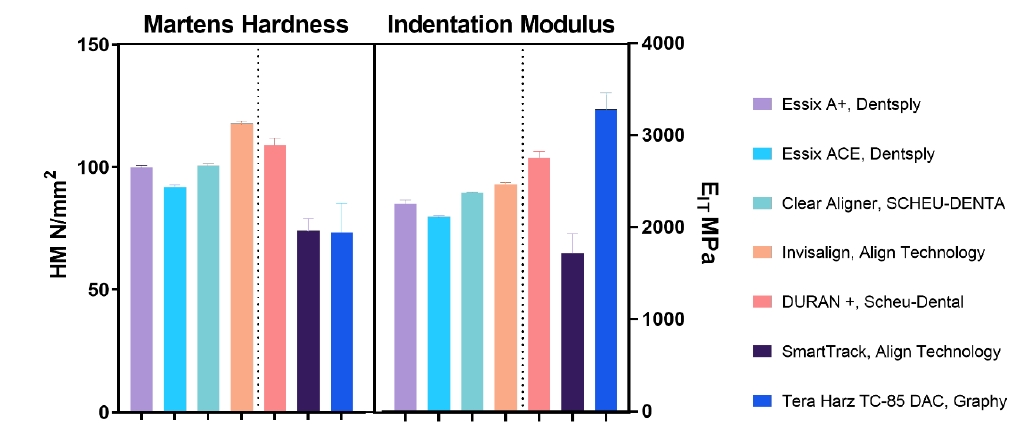
1) 재료별 경도, 탄성계수 특성(Figure 1)
단층 재료
탄성 계수는 하중을 받는 동안 재료의 강성 또는 탄성 변형에 대한 저항성을 측정한 것이다. 간략히 말해서, 주어진 힘에 따라 재료가 얼마나 구부러지거나 늘어나는지를 나타낸다. 최근 투명교정 재료의 물리적 특성을 압입시험(Instrumented indentation testing, IIT)을 이용하여 평가하기 시작하였으며 기존 방식과 달리 시편 재료 상에 um 단위의 압입력을 부여하여 Martens harness (HM), indentation modulus(EIT), elastic index(ηIT), Indentation creep(CIT) 등을 계측한다. HM 은 내구성과 내마모성을 나타내며, EIT는 재료 강성과 연관이 있으며 ηIT은 변형에 대한 저항, 재료의 취성을 설명하며, CIT는 변형 가능성을 나타낸다.
2013년에 투명교정 재료 별 탄성계수에 대한 비교 연구에서 Duran(Scheu-Dental, Iserlohn, Germany)과 Erkodur(Erkodent Erich Kopp GmbH, Germany)는 모두 PETG 구조로 유사한 기계적 특성이 보고되었고 Hardcast(Scheu Dental, Iserlohn, Germany)는 Polypropylene 구조로 평균 경도와 탄성 계수가 현저히 낮게 보고되었다[5]. 다른 연구에서는 실제 마모를 유도하여 PETG가 다른 2종의 Polypropylene, 보다 마모 저항성이 높다는 것을 보고하여 재료들 간의 물리적인 차이점을 확인할 수 있다[6]. 단층 PU에 대한 물리적 특성 연구에서 Exceed 30(EX30, Align Technology, Inc., San Jose, CA, USA)가 PETG 기반 제품보다 경도와 탄성계수 값이 더 높은 것으로 보고되었고, 이는 Exceed30 재료가 더 견고하고 변형에 더 강하여 치아 이동에 필요한 힘을 강하게 전달할 수 있음을 의미한다(Fig. 1) [3]. 또한 PU 가 PETG 보다 마모 저항성과 탄성이 높아 치료기간동안 장치의 파절 가능성이 있다는 점도 보고되었다[7].
다층재료
최근 다층구조의 SmartTrack이 소개되면서 기존 단층 구조의 EX30 와 물리적인 비교연구가 있었으며 건조 및 습윤 조건 모두에서 다층구조의 PU 소재가 단층 PU 구조에 비하여 탄성계수와 최대신장력이 낮아서 장치의 착탈이 더 용이할 수 있다고 제시된바 있다[8]. 다층 구조인 CA pro와 Zendura FLX(Bay Materials, Fremont, CA, USA)도 단층 재료인 Duran+(Scheu-Dental, Iserlohn, Germany), Zendura (Bay Materials, Fremont, CA, USA)에 비해 훨씬 낮은 탄성계수 값이 보고되었다[9]. 이는 Duran+ 투명교정 장치가 처음에는 Zendura FLX보다 더 단단하고 굽힘에 더 강하다는 것을 의미하며, 더 강한 초기 교정력을 부여할 수 있다고 할 수 있다. 따라서 다층구조의 재료가 장치의 착탈과정이 더 용이할 수 있고 낮은 초기 교정력을 부여하여 환자의 초기 통증을 낮출 수 있으며 장치의 파절을 예방할 수 있다고 평가되고 있다. 2023년 최근 연구에서는 열성변형재료와 직접프린팅 투명장치를 비교를 제시했다. 투명교정 샘플 중 Duran 그룹이 가장 높은 Martens 경도를 나타내어 내마모성이 우수한 것으로 나타났다(Fig. 1) [4]. 직접프린팅 재료의 물리적 특성이 PU-based aligners(SmartTrack)와 유사하기 때문에 마모 저항성에 대해서는 임상적으로 받아들여질 수 있다고 보고되었다.
직접 프린팅 재료
직접 프린팅 재료(Tera Harz TC-85, Graphy, Seoul, Korea)는 PETG와 PU 계열의 재료와 비교하여 압입 탄성율(EIT)가 가장 높고 변형에 대한 저항력이 가장 높은 가장 견고한 재료였으며 Duran, SmartTrack이 그 뒤를 이었다. 탄성지수(ηIT, elastic index) 역시 Duran에서 가장 높게 나타나 다른 것에 비해 취성이 높다고 볼 수 있다[10]. 하지만 본 실험은 체내 조건이 아닌 실온상태에서 평가되었다는 점에서 연구 결과 해석에 주의를 해야 한다. 구강 환경에서 투명교정장치의 탄성 계수, 최대 인장 강도 및 응력 완화가 눈에 띄게 변화함을 강조하였다. 이러한 환경은 열성형재료보다 직접 프린팅 교정 장치에 더 큰 영향을 미치는 것으로 보고되었다.
투명 교정 장치의 재료는 다양한 수준의 탄성 계수를 나타내며 강성, 탄성 및 힘 적용 방식에 영향을 미칠 수 있다. 따라서 교정 의사는 이러한 차이점을 이해하여 교정 치료에 필요한 요구 사항을 기반으로 환자에게 가장 적합한 교정장치를 선택할 필요가 있다.
2) 장치의 적합도와 정확성(Fitness and accuracy)
다층구조와 직접 프린팅 투명장치의 두께 변화와 적합도는 더 우수한가?
열성변형 투명장치의 적합도에 대한 보고는 많지 않으나 새롭게 소개되는 다층 구조의 투명장치 재료와 직접 프린팅 투명장치의 다양한 후처리 과정에 대한 투명장치의 두께와 적합도 평가 연구가 필요하다 [16,17]. 투명 교정장치의 두께와 적합도는 치아 이동에 필요한 힘과 모멘트에 영향을 줄 수 있어 성능 예측 가능성을 높이는 데 임상적으로 중요한 요소가 되기 때문이다[18,19].
Cole 등은 광학적인 중첩 기술을 사용하여 평가한 열성형 및 3D 프린팅 투명장치의 치수 정확도가 각각 0.1~0.3 mm 및 0.1~0.4 mm 로 보고 하였다[20]. 그러나 중첩 방법에 따라 오차가 발생될 수 있기 때문에 최근 비파괴적인 방식을 활용하여 장치의 적합도 평가 방식이 제안되었다.
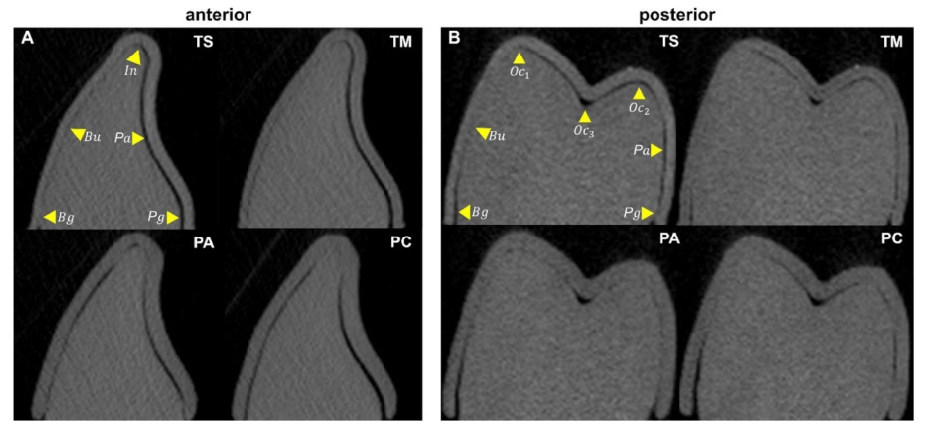
박 등은 열성형된 투명장치와 직접 프린팅 투명교정장치의 두께 변화와 적합도에 대한 비교 연구를 위하여 MicroCT 를 이용한 분석방법을 활용하였다. PETG 시트(Duran)를 사용하는 단층 그룹(TS 그룹)과 다층 그룹(TM 그룹, CA pro), 그리고 광중합성 PU 수지(Tera Harz TC-85)를 사용한 직접 프린팅 투명교정장치의 경우 이소프로필 알코올 세척을 사용하는 PA 그룹과 원심분리 세척을 사용하는 PC 그룹의 두 그룹으로 분류하여 비교 평가하였다.
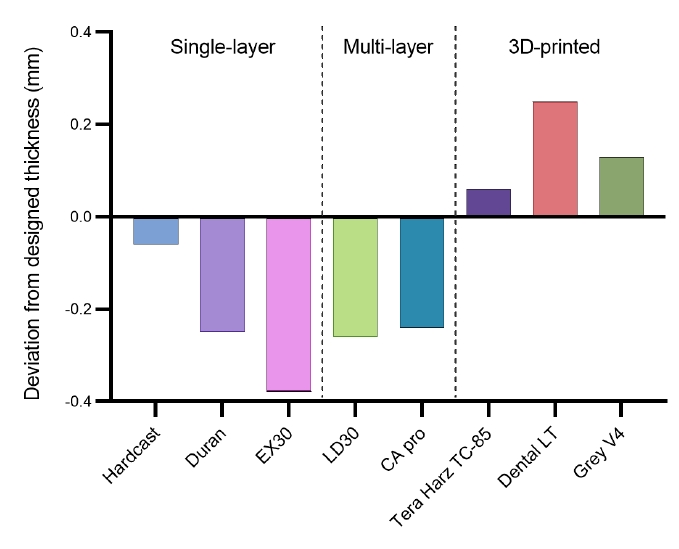
가공 후 두께 변화(Figure 2)
열가소성 소재는 열성형 과정에서 두께가 감소하는 반면, 직접 프린팅된 교정장치는 두께가 증가하는 것으로 나타났다[15,21]. 제조 후 열성형 그룹에서는 다층 그룹에서도 30~50% 두께 감소가 관찰되었으나 TS 군과 TM 군 간의 두께에 유의한 차이는 관찰되지 않았다. 반면, 3D 프린팅 그룹에서는 PA군에 비해 PC 군에서 전체적인 두께의 증가가 관찰되었으며 평균 114~187um의 두께 증가가 관찰되었고 교합면에서 가장 큰 증가가 관찰되었다. 기존 연구에서 이 등은 표준화된 상악 절치 모델에서 열성형된 PETG 샘플의 두께 54.7%가 감소했다고 보고했다[15]. Edelmann 등도 3D 프린팅된 CA는 프린팅 후 두께가 약 0. 2mm 증가하는 것으로 나타나[12]. 제조 공정에서 광중합 레진의 점성에 의한 두께 증가를 고려하여 장치 설계 시 내부에 적절한 옵셋값을 설정해야한다.
적합도
투명장치의 적합도에 있어서는 다층(TM) 그룹이 적합도가 가장 우수한 것으로 나타났다. 가장 작은 것으로 나타났다(p<0.01). 열성형 및 직접 프린팅된 투명장치는 치아 유형 및 위치에 따라 두께와 적합도가 다양했다. 순측면의 적합도가 20um 미만이었으나 구개측이나 잇몸 쪽의 경우 60~90um 정도의 유격이 관찰되어 큰 차이가 관찰되었다. 직접 프린팅 PA, PC 의 경우에서도 잇몸부위에 유격이 80~99um 관찰되었다(Fig. 3).
치아 부위별 투명장치 적합도 비교
TS(단층): 협측, 협측 치은 < 구개측, 구개 치은, 절단측 또는 교합측
TM(다층): 협측치은 < 구개측, 절단측 또는 교합측, 구개 치은;
PA(직접 프린팅, 알코올 세척): 구개측 < 협측, 절단 또는 교합면 < 구개 치은, 협측 치은
PC(직접 프린팅, 원심분리 세척): 협측, 절단 또는 교합면 < 구개측, 협측 치은, 구개 치은
실험을 통해 다층구조의 재료에서 적합도가 우수하였고 모든 열성변형재료에서 순측의 적합도가 우수하였다. 직접 프린팅 그룹의 경우 원심분리시 두께의 증가가 있었으며 잇몸쪽에 치아와의 유격이 증가되는 것을 확인할 수 있었다.
직접 프린팅의 경우 출력 방향이 정확도에 영향을 미칠 수 있다. 직접 프린팅 투명교정 장치는 컴퓨터 지원 설계 소프트웨어(Deltaface, Coruo, Limoges, France)를 사용하여 설정 두께 0.5mm, 오프셋 50μm, 인쇄 각도 30°로 설계되었다. 출력 방향은 장치의 출력 시간과도 연관되기 때문에 적절한 출력각도를 찾는 것이 중요하다.
3) 응력완화(Stress relaxation)
투명 교정장치는 장기간 사용 시 점탄성 특성을 나타낸다. 즉, 하중이 가해질 때의 동작은 시간이 지남에 따라 변한다. 시간이 지남에 따라 점탄성 재료는 일정한 하중 하에서 더 많이 휘어지는 경향이 있어 변형이 증가하는 것으로 나타난다. 반대로, 하중이 감소하면 이러한 재료는 일정한 수준의 편향을 유지한다. 이러한 행동을 스트레스 완화라고 한다. 투명 교정장치 재료의 응력 완화는 치아 이동 효율성에 매우 중요하므로 투명 교정장치의 효과를 평가하는 데 가장 중요한 측면일 것이다[24]. 치아교정을 위해서는 일정한 힘의 전달이 필요하다. 그러나 투명 교정장치 재료는 니켈-티타늄 교정용 호선과 비교할때 힘의 전달 부분에 있어 취약하다[23,25].
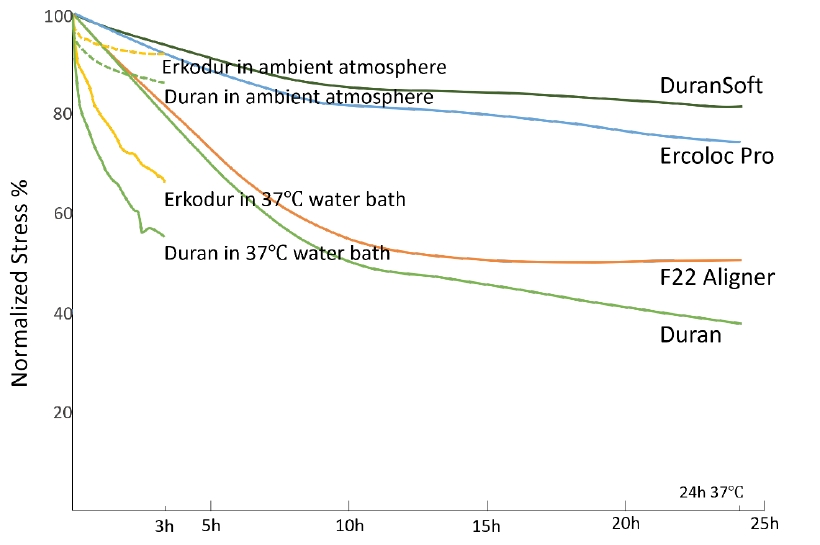
투명 교정장치의 고전적인 힘 측정 방식으로 시험기에 적합한 아령 모양의 시편에 교정용 열가소성 재료를 제작하여 전통적인 응력 완화 테스트를 사용했다[22]. 기존 연구에서는 짧은 관찰 기간(3시간) 또는 상대적으로 작은 변형(5% 변형)으로는 투명교정 재료에 대한 응력 완화에 대한 명확한 특성을 제시하기 어렵다. 특히 37.0°C 수조에서의 응력-변형 거동은 건조 환경에서의 거동과 크게 달랐으며, 고온 노화 환경은 열가소성 재료의 응력 완화를 가속화할 수도 있다. 응력 완화 거동은 동일한 테스트 환경 내에서 재료마다 다르다(p<0.05)(Fig. 4). PETG 기반 재료 내에서도 Erkodur는 건조 환경에서 가장 느린 완화 속도를 나타냈고, Duran은 두 환경 모두에서 Erkodur에 비해 더 빠른 완화 속도를 나타냈다. 이는 화학적 조성 및 분자 구조와 관련이 있을 수 있다.
최근에는 응력센서를 이용하여 PETG 교정 장치(Erkodent, Erich Kopp GmbH, Pfalzgrafenweiler, Germany)에 의한 중절치의 설측 치체 이동에 대한 교정력을 측정하였으며 관찰 기간을 2주로 연장했다[26]. 연구 결과 교정 장치의 초기 활성화의 수준과 두께가 교정력의 응력완화에 영향을 미친다는 점을 발견했다. 특히, 모든 교정장치는 처음 8시간 이내에 급격한 힘 완화를 경험한 후 4~5일차에 점진적인 감소 및 안정화를 보여주었다. 처음 8시간 동안 두께 0.2, 0.3, 0.4 mm 그룹의 감쇠 속도는 0.5mm 및 0.6mm 그룹의 두께보다 느렸다(p<0.01). 1~14일 동안 0.6 mm 그룹의 감쇠 속도가 다른 그룹보다 빨랐다(p<0.05). 이러한 결과는 디지털 교정 계획에서 교정 장치의 착용 시간을 결정하는 데 중요한다.
다층 재료
단층 및 다층 구조의 투명교정 재료에서 37℃의 물이 담긴 수조에서 교정력을 가한 후 24시간 동안 착용 초기에 응력 완화가 50%를 초과하는 것으로 나타났다[23]. 해당 연구에서는 단층 재료(F22 Aligner, 스웨덴 & Martina, Due Carrare, Padova, 이탈리아 및 Duran, SCHEU, Iserlohn, 독일)와 다층 재료(Erkoloc-Pro, Erkodent, Pfalzgrafenweiler, 독일 및 투명 교정 장치에 사용되는 Durasoft, SCHEU)를 평가하였으며 처음 8시간 이내에 모든 재료가 빠르게 완화되며, 일부 재료는 안정화되었고 다른 재료는 지속적으로 감소하였다. 단층 PU는 가장 높은 초기 응력과 가장 빠른 완화를 보이는 반면, 단층 PETG는 가장 높은 24시간 응력 완화를 나타냈다. 다층 재료인 Erkoloc-Pro는 24시간 동안 75.5%의 응력을 유지했으며 Durasoft는 82.1%를 유지했다(Fig. 4). 전체적으로 단층 재료에 비해 초기 응력이 낮고 응력 완화가 느리다는 특성이 관찰되었다.
Albertini등은 14일 동안 일정한 변형을 가한 5가지 서로 다른 열가소성 교정 장치 재료의 응력 완화 특성을 조사한 결과 적용 후 처음 몇 시간 동안 응력 완화의 속도가 빨라졌지만 단층 Duran과 다층 Duransoft 모두에서 유사한 잔류 응력을 나타내었다(Duran 3.9%, Duransoft 4.6%) 27) . 동시에, 단층 재료(F22 Evoflex, 스웨덴 & Martina, Due Carrare, 이탈리아 파도바)와 다층 재료(Erkoloc-Pro, Erkodent, 독일 팔츠그라펜바일러)의 잔류 응력 비율은 39.2%와 36.9%을 각각 유지하였다.
직접 프린팅 레진에 대한 최근 연구에서는 37°C에서 60분 동안 1% 신장과 60분 동안 회복의 13주기 하중 하에서 두 가지 재료인 TC-85와 PETG의 응력 완화 거동을 조사했다[15]. 초기에 TC-85는 약 18N의 정적인 힘을 나타내다가 1.0 N으로 빠르게 완화되었다. 반복적인 주기로 응력 완화는 감소하고 잔류 힘(이완 후 남아 있는 힘)은 증가했다. 하중 제거 시 TC-85의 변형률 회복률과 정도가 점차 향상되었다. PETG는 약 13 N의 정적 힘으로 시작하여 11.39 N으로 감소했고 하중 제거 시 변형률의 80%가 즉시 회복되고 나머지 20%는 점진적으로 회복되었다. 반복 하중 하에서 PETG의 잔류 힘과 변형률 회복률도 증가했지만 TC-85만큼 뚜렷하지는 않았다.
최근 IIT를 활용한 연구에서는 직접 출력 재료(Tera Harz TC-85 DAC resin)가 PU(SmartTrack) 및 PETG에 비하여 4배(Duran+) 정도 힘 감소율이 높다는 것이 보고되었다[4]. 7일 동안 37°C에 담근 샘플을 대상으로 2시간 동안의 응력 완화 테스트를 실시한 또 다른 연구에서는 직접 출력 재료인 Material X(Envisiontec) 및 OD-Clear TF(3DResyns)는 10% 미만으로 힘이 남아 있는 반면, PU 기반 LD30(Align Technology) 및 EX30(Align Technology)은 50% 이상 남아 있었다. 앞으로 투명 교정장치를 직접 출력할 가능성이 매우 높지만 열성형 교정장치에 비해 응력 완화가 높아 형상기억과 같은 기능들이 함께 추가될 필요가 있다는 것을 보여준다[11].
4) 구강 내환경에서 투명교정 장치의 재료의 노화(aging)
복잡한 구강 환경에 노출된 투명 교정장치는 다양한 어려움을 겪게 된다. 타액, 온도 변화 및 기계적 응력이 발생하여 재료 무결성과 기계적 특성에 영향을 미친다. 경도, 탄성 등 투명교정 재료 특성의 변화는 구성 요소인 열가소성 폴리머의 물리적 특성과 화학적 조성에 영향을 미쳐 가수분해, 물 분해, 온도 변동과 같은 요소의 영향을 받는다[24]
오랫동안 구강 환경이 투명 교정 장치에 미치는 영향을 재현하고자 노력하였지만 구강 내 상태를 완전히 재현할 수 없기 때문에 관련 임상 연구가 필요하다. 따라서 2주 착용 후 회수된 Invisalign 투명 장치의 화학적 및 물리적 특성을 조사한 연구 조사에 따르면 투명 교정 장치는 미세 균열, 마모, 박리, 국부적인 석회화된 생물막 침전물 및 투명성 손실을 나타냈다[28]. 반면 투명교정장치를 인공 타액에 14일 동안 침전시켰을 때 모노머나 부산물이 전혀 배출되지 않는 것으로 관찰되어 재료의 화학적 안정성을 나타냈다. PET-G 기반 열가소성 투명 교정 장치를 사용한 또 다른 구강 내 실험에서는 10일 동안 완전히 사용한 후에 교정 장치의 교합면 두께에 약간의 변화만 있는 것으로 나타났다[29]. 이는 교정용 교정 장치가 치료 중에 우수한 치수 안정성을 유지했음을 시사한다.
기계적 성질의 안정성은 어떠한가?
IIT를 적용한 연구에서는 사용된 Invisalign의 재료의 1~2주간 사용 후 기계적 특성이 사용 전 재료의 그룹과 비교하여 HM, EIT 및 RIT와 관련하여 통계적으로 유의미한 차이가 보고되었다[30]. 이 결과는 다른 연구에서 평균 44±15일의 구강 내 사용 기간 후에 재료의 EIT, HM는 현저히 감소되고 ηIT 및 CIT는 크게 증가한다는 다른 임상시험에서 수집된 분석 결과와 유사하다[11]. 이는 구강 내 사용된 PU 교정 장치는 사용되지 않은 장치 보다 더 부서지기 쉽고 일정한 변형 하에서 가해지는 힘이 더 낮다는 것을 의미한다. 이러한 기계적 특성의 저하는 PU의 연화 메커니즘과 제조 공정 및 매트릭스 가소제의 침출로 인한 잔류 응력 완화로 설명될 수 있다. 그러나 1, 2주 간의 사용 그룹 간에는 유의미한 차이가 발견되지 않았으며 이는 노화 효과가 임상 사용 첫 주에만 제한된다는 것을 의미한다.
Tera Harz TC-85, SmartTrack(LD30) 및 DURAN+ 등 열성형 재료를 포함하여 직접 출력된 교정 장치와 관련된 최근 연구에서는 사용 전 샘플과 사용된 샘플 간의 기계적 특성에 상당한 차이가 있는 것으로 나타났다(P<0.001) [4]. 그러나 구강 내 사용 7일 후 Invisalign과 Duran 교정 장치에서는 사용 전후 재료에 대한 기계적 특성에는 큰 차이가 없었다. 대조적으로, 직접 출력된 투명교정장치의 경우, ηIT의 상당한 증가와 indentation relaxation(RIT)의 상당한 감소가 관찰되었다. 직접 출력 그룹에서 2개의 교정장치 파손이 보고되었으며 이는 ηIT의 증가로 설명될 수 있으며 취성 증가는 구강 내 환경에서 발생되었다. 반면, 또 다른 생체 내 연구에서는 직접 출력 재료(TC-85 DAC)에 대한 사용된 장치와 사용 전 장치 사이의 기계적 특성에 차이가 없음을 발견했다[31]. 테스트된 직접 프린팅 교정장치의 기계적 특성은 사용 일주일 후에도 영향을 받지 않았다. 이러한 장치의 노화에 대한 일관되지 않은 결과는 연구의 제한된 표본 크기와 부착물에 대한 유무, 단계별 활성화 및 실험 조건에 기인될 수 있다. 따라서 구강 내 장치의 노화 효과에 대한 명확한 결론을 내리기 위해 큰 표본 크기를 바탕으로 임상연구가 함께 진행되어야 한다.
5) 형상기억 폴리머 (shape memory polymer, SMP) 특성
최근 투명교정 재료의 발전으로 인해 기존의 재료의 특성을 뛰어넘는 형상기억폴리머(SMP)가 개발되었다. 외부 자극, 특히 열 변화에 반응할 수 있는 이러한 스마트 소재는 투명 교정 장치의 효과를 향상시킬 수 있는 잠재력을 가지고 있다. 온도 변화에 따라 원래의 모양으로 되돌아갈 수 있는 이러한 폴리머의 독특한 형상 기억 효과는 치아 이동을 위한 교정력을 생성할 수 있다. Elshazly et al.는 타이포 돈트 시험연구에서 단층 열반응형 SMP 투명교정 장치(ClearX 시트로 제작)의 93%의 수정 효율성(Correction efficiency) 보고하면서 형상기억 폴리머 장치 적용의 타당성을 제시하였다[33].
E-Guard(Envision TEC, Rockhill, SC, USA), Dental LT Clear V1(Formlabs, Inc, Somerville, Mass, USA), TC-85 DAC(Graphy, 대한민국 서울)과 같은 여러 브랜드의 직접 출력 레진이 문헌에서 언급되었다. 이전 연구에서 직접 프링팅되는 투명교정 수지는 주로 광중합체 또는 광중합성 폴리우레탄으로 구성된다. 특히, 형상기억 특성을 인정받은 TC-85의 경우, 기존 분광분석을 통해 주로 지방족 비닐에스테르-우레탄 고분자로 구성되어 있으며, 시험 수조 내에서 37℃에서 지속적으로 부드러운 힘을 가할 수 있는 가능성을 보여주었다.
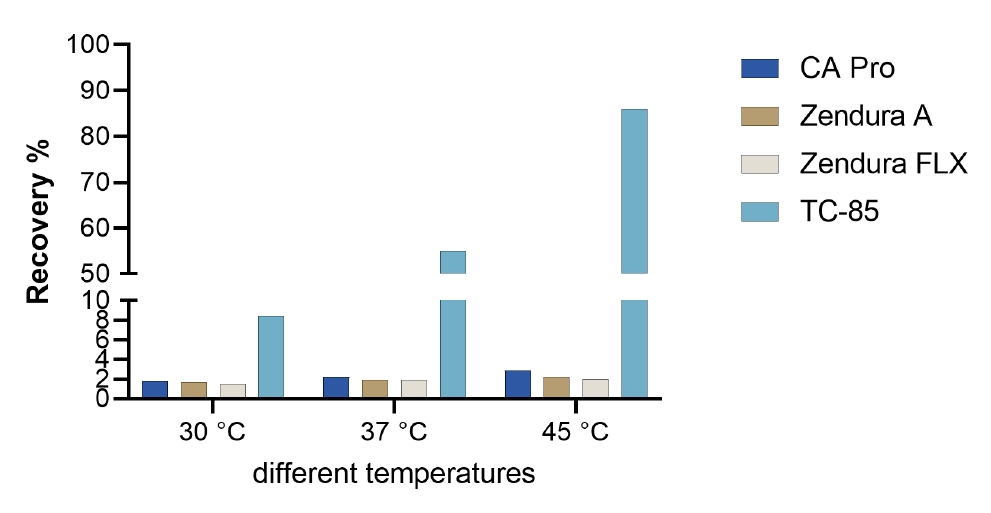
가장 최근 연구에서는 30°C, 37°C 및 45°C에서 3개의 열성형 재료와 1개의 3D 프린팅 재료인 Tera Harz(TC-85)의 형상 회복을 평가했다[32]. 기존 열성형 재료는 30~45°C의 온도 범위 내에서 최소한의 형태 회복(1.5%~2.9%)을 나타냈다. 대조적으로, TC-85는 30°C에서 8.4%에서 시작하여 37°C에서 54.9%, 45°C 에서 86.1%로 증가하는 상당한 회복을 나타냈다 (Fig. 5). TC-85는 구강 온도 범위에서 뛰어난 형상 기억을 보여주었고 적용 시 적응력이 향상되고 힘 손실이 감소했음을 시사한다. 그러나 TC-85의 저장 탄성률 (Storage modulus)은 온도에 따라 큰 변화를 보였다.
6) 세포독성
투명교정 장치 재료의 생체적합성도 중요한 고려사항이다. Martinaet al. 는 Duran(독일), Biolon(독일), Zendura(미국) 및 SmartTrackTM(미국) 등 4가지 열가소성 소재의 생체 적합성을 평가하는 연구를 수행했다[25]. 연구 결과에 따르면 Biolon은 인간 치은 섬유아세포(HGF)에 대해 가장 높은 수준의 세포 독성을 나타냈으며 Zendura와 SmartTrackTM이 그 뒤를 이었고 Duran이 가장 낮은 독성 수준을 나타냈다. Eliades가 실시한 체외 연구에서는 Invisalign 장치의 세포 독성과 에스트로겐성을 조사했다 34) . 이 연구는 특히 MCF-7 유방암 세포의 증식을 측정하여 HGF에 대한 잠재적인 세포 독성 효과와 에스트로겐 영향을 평가하는 데 중점을 두었다. 연구 결과에 따르면 Invisalign 장치는 에스트로겐 효과를 유발하지 않아 호르몬 영향 측면에서 생체 적합성이 강조되었다.
3D 프린팅 재료의 독성 프로필은 눈에 띄는 변화를 나타냅니다. 이러한 재료는 3D 프린팅 공정 전에 상당한 독성을 나타내며, 이는 중합 단계 후에 눈에 띄게 감소한다. 이를 보완하기 위해 Pratsinis은 체외 연구에서는 TC-85 수지를 사용한 최신 직접 출력 교정 장치의 세포 독성과 에스트로겐성을 조사했다[35]. 이 연구는 항산화 활성을 포함하도록 평가를 확장했다. 연구에서는 이러한 직접 프린팅 투명교정 장치가 인간 치은 섬유아세포에 세포독성을 나타내지 않았고, 세포내 활성 산소 수준에 유의미한 영향을 미치지 않았으며, 테스트된 용출액에서 에스트로겐 효과를 나타내지 않았다는 결론을 내렸다.
반면 현장에서는 대조적인 관점이 뚜렷이 드러난다. 한 연구에서는 다양한 투명 정렬 장치의 안전성을 비교한 결과 Zendura와 Smart Track이 약한 세포 독성을 보인 반면 Duran은 더 높은 세포 생존력을 보인 것으로 나타났다. ISO 표준에 따르면 Zendura를 제외한 각 브랜드의 교정장치의 임상적 사용은 신뢰할 수 있는 것으로 간주될 수 있다[36].
MTT 분석을 사용하여 다양한 시간 간격에 대[37]한 광중합 직접 출력 투명교정 재료의 세포 독성을 평가하기 위한연구에서는 Invisalign의 재료가 세포에 가장 덜 유해한 것으로 나타났다[37]. 이어 Dental LT clear resin(Form Labs)과 Accura 60 SLA(3D Systems)가 뒤따랐다. 그러나 이 마지막 두 재료는 직접 출력 투명 교정 장치에 대한 공식적인 승인을 받지 못했다.
지난 20년 동안 열성형 투명 교정 장치가 전 세계적으로 확산됨에 따라 직접 출력된 교정 장치의 다음 경향은 체외 및 생체 내 연구를 통해 무해한 것으로 확인된 후 임상에 신중하게 적용되어야 한다. 특히 원내에서 제작된 투명교정 장치는 후경화 과정에 의해 큰 영향을 받는 것으로 보고되었다. 제작하는 동안 기술자는 지침을 엄격히 준수하는 것이 좋다.
7) 특수 코팅 재료 (Coated biomaterials)
투명교정 장치에 항균 기능을 더한 재료들도 소개되고 있다. 초친수성 코팅은 의료기기 표면과 바이오필름 사이의 상호작용을 방해하는 얇은 수막을 형성하여 바이오필름 부착을 억제한다[38,39].
항균효과를 발휘하는 친수성 코팅의 방법으로, layer-by-layer 기법 및 가교 기술의 도입을 통해 clear overlay appliance 재료로 일반적으로 사용되는 PETG 표면에 carboxymethyl cellulose(CMC)와 키토산(chitosan)으로 구성된 multilayer film 코팅을 개발하여 소개된 바가 있다[40]. 이렇게 층별로 코팅된 COAs는 향상된 화학적 안정성, 기계적 강도, 항균효과(~75%의 박테리아 감소율)를 보였다[41]. 다른 연구에서는 PSQ(polysilsesquuioxanem)을 코팅한 PETG 시트에서 구강내 3가지 다른 박테리아에 대해 박테리아의 밀도를 감소시켜 대조군에 비해 60% 이상의 세균 감소율을 보여주었다[41]. 최근 국내에서 친수성과 항균 효과가 있는 아민 그룹을 가지는 고분자 polyethylenimine(PEI)를 이용하여 표면에 적층하는 항균 코팅 재료들이 소개되었다. 다만 구강내 환경과 장치 세척 과정에서 항균효과가 유지되는지에 대한 연구가 필요하다.
Ⅲ. 결론
투명교정 재료는 계속 진화하고 있다. 다층구조의 열성변형 재료는 기존 단층 재료에 비하여 탄성계수는 낮아서 장치의 착탈이 용이하고 환자의 불편감을 감소시킬 수 있다. 또한 힘의 감쇠가 낮다는 점에서 치아에 교정력을 지속적으로 전달할 수 있다. 그러나 모든 열성 변형 재료는 구강내 열악한 환경에서 힘의 상쇄가 두드러지기 때문에 임상적인 효과 통한 검증이 필요하다. 직접 프린팅 재료는 형상기억 특성으로 각광받고 있으나 구강내 환경에서 힘의 완화가 기존 열성 변형 재료보다 커서 잔류힘의 임상적인 교정 효과에 대한 연구가 뒷받침되어야 한다.


 PDF Links
 PubReader
 ePub Link
 XML Download
 Full text via DOI
 Download Citation
 Print
Print